From Promptbook to Production Memory
A promptbook preserves entrances, cues and staging choices, helping a theatre production keep its working shape as performers and crews change.
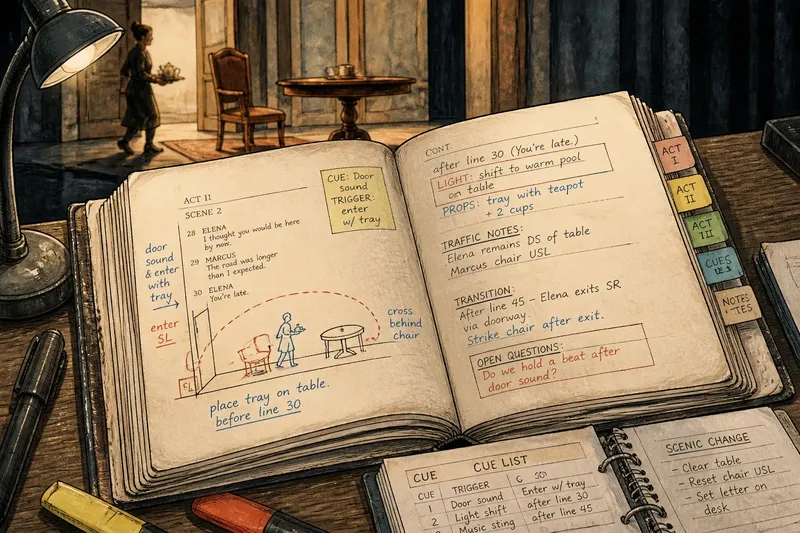
The common mistake with a promptbook is to treat it as a script with a few marks in the margins. That undersells what it preserves: the practical map that lets performers, stage management and crew coordinate a live production. A promptbook can record entrances, cues and staging decisions, keeping the show’s working shape legible after the rehearsal room empties.
A promptbook records how the script became playable
A promptbook is the production copy of a script used to track the work of rehearsals and performance. Its pages may hold blocking notes, cue placements, changes to dialogue, prop movements and reminders about timing. The exact contents vary by company and production, but the purpose is consistent: make decisions findable when people need to act on them.
The word “prompt” points to one familiar task: helping performers recover a line if they lose their place. But the book is not merely a safety net for dialogue. It can also tell a stage manager when a sound cue follows a particular word, where an actor crosses, or which scene change must be complete before the next entrance.
That practical record develops over time. A working script begins as a text to interpret; rehearsal adds choices about movement, rhythm and coordination. The promptbook gathers those choices in a form that can be used again, rather than relying on someone’s memory of a busy afternoon.
Its history follows the growth of organized stage management
Before the modern promptbook took its familiar shape, theatrical performances still depended on someone keeping track of entrances, music and practical changes. As theatre companies became more organized and productions grew more technically coordinated, written records became increasingly useful. A book could collect cues and stage business in one place, especially when the person responsible for calling the show needed a dependable reference.
The promptbook has never been a single fixed object. In some settings it may be a heavily annotated printed script; in others, a binder or digital document with the script, cue sheets and supporting notes. The format changes with a company’s tools and habits. What remains is the link between the written play and the repeatable actions that make a particular staging work.
That distinction matters. A script may survive in print while the details of one production fade: the order of a complicated entrance, the handoff of a letter, the cue that lands on a movement rather than a line. The promptbook gives those local decisions a place to live. It is not a complete account of the production’s artistic meaning, but it can preserve the evidence of how that meaning was made playable.
Entrances, cues and traffic turn notes into a working map
A useful promptbook shows relationships, not just isolated instructions. An entrance depends on what happens immediately before it. A cue may depend on a line, a gesture, a lighting state or a change in the room’s focus. Blocking notes are most useful when they help people understand where performers move in relation to furniture, other actors and the audience’s view.
For example, imagine a production in which a performer enters carrying a tray just as a door sound plays. During rehearsal, the team settles on the performer entering from stage left, crossing behind a chair and placing the tray before the next line. A promptbook could record the entrance, the cue’s trigger and the tray’s destination. If a substitute stage manager takes over, those linked notes offer a clearer picture than “door, then tray” scribbled without context.
Good notation is concise but specific enough to prevent ambiguity. “Cross” may be meaningless if the room has several possible paths; a note tied to a named piece of scenery or a clear stage position is easier to use. Some productions use standard abbreviations, while others develop a house style. The important thing is that the people who rely on the book can read it consistently.
What belongs in a promptbook, and what does not?
The book should preserve decisions that affect the repeatable running of the production, without trying to capture every thought spoken in rehearsal. A passing idea that was never adopted need not sit beside the final blocking. Too many abandoned alternatives can obscure the current version, especially under pressure before a performance.
- Entrances and exits: note the relevant page or line, the performer, and the route or point of entry when it is not obvious.
- Performance cues: mark the trigger and the cue that follows, such as a line, action or agreed visual signal.
- Blocking and traffic: record meaningful crossings, positions and interactions with scenery or hand props.
- Scene transitions: capture who moves what and the order needed for the next scene to be ready.
- Current revisions: keep the working text and any approved changes aligned, so an outdated line does not prompt the wrong cue.
- Open questions: distinguish unresolved items from settled instructions, then update the record when the team decides.
A promptbook is not usually the place for a full review of the production or an actor’s private process. Those concerns may matter artistically, but they serve a different purpose. Keeping the record focused makes it faster to scan and easier to hand over.
How does a promptbook preserve a production over time?
Can a promptbook recreate the original performance?
It can preserve many practical choices, but it cannot reproduce the full event. A book may record a crossing and cue while leaving out the exact energy, texture and audience response that made the moment distinctive.
Who updates the promptbook during rehearsals?
Stage management commonly maintains the production record, gathering decisions from the rehearsal room and clarifying notes as the staging settles. The process varies between companies, so performers and department leads may also supply information that affects their work.
Can a digital promptbook do the same job as a paper copy?
Yes, if it is readable, accessible to the people who need it and kept current. Digital files can make revisions and sharing easier, while a paper binder offers a dependable physical reference; the useful choice depends on the production’s workflow.
What makes a handover useful?
A handover should identify the current version, explain any shorthand and flag unresolved points. The incoming person also needs to know where supporting documents live and which notes are essential for calling or running the show.
Production memory needs maintenance, not just storage
A saved file or binder is not automatically a reliable record. Rehearsal changes can leave the script, cue list and prop notes out of sync. A useful production routine makes it clear who updates the authoritative copy, how changes are marked and how old versions are set aside rather than mistaken for current instructions.
For a small company, that may mean a clearly labeled binder and a shared folder with one current script. A larger production may use dedicated stage-management software or a digital script annotation tool. Whatever the format, a note should be easy to locate at the moment it matters, and a handover should make the record understandable to someone who did not attend every rehearsal.
The promptbook’s deeper value is not that it freezes a performance. Live theatre changes from night to night, and performers remain present rather than mechanically repeating marks. Instead, the record preserves the structure that lets variation happen within a shared arrangement: the entrance still meets the cue, the prop reaches the right hand, and the next scene is ready.
That is why a promptbook can be read as production memory. It carries forward the decisions that a script alone cannot show, while leaving room for the living work to breathe. When the record is clear and current, a production can be handed on without pretending that its human details fit neatly on the page.