Thrust Stage or Proscenium? What Changes for the Audience
Thrust stage or proscenium: learn how seating, sightlines, distance, and direct address change what you notice, so you can read a production on its own terms.
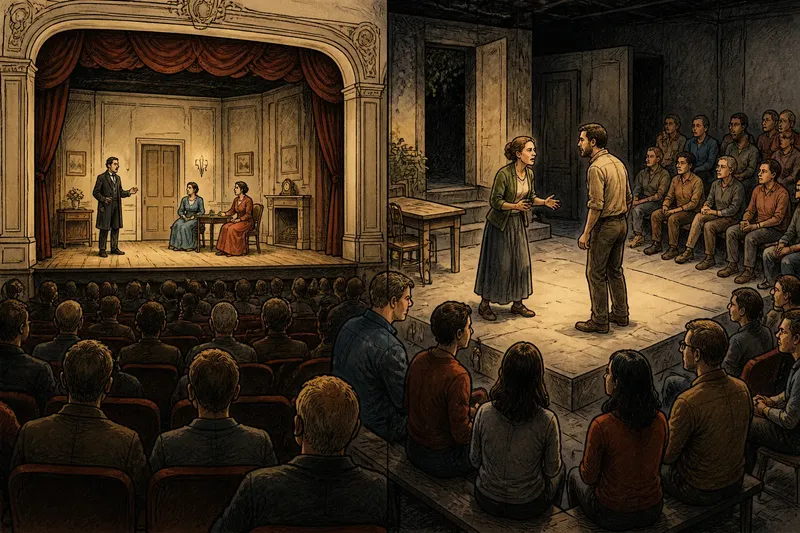
The most common mistake in comparing a thrust stage or proscenium is to treat the layout as scenery: one puts actors “in the round,” the other frames them like a picture. That shortcut can make you miss the real difference—where the audience sits in relation to the action, and how that position changes what a scene can communicate. A thrust stage or proscenium is not simply a visual style; each asks performers and spectators to share space differently.
You can read that difference before the first line, then keep checking it as the scene unfolds. Notice where you sit, what the actors can see, and whether a moment seems addressed to one person, a whole side of the room, or everyone at once. These observations help explain why the same scene may feel intimate in one layout and carefully composed in another.
Start with the audience’s position
A proscenium stage places the main playing area beyond an architectural frame, with the audience generally facing it from one side. The frame helps create a strong shared direction: actors can arrange a picture toward the house, and the audience tends to look at the same broad plane. The arrangement can make entrances, exits, and shifts in focus easy to read, though seats far to one side may see some action at an angle.
A thrust stage extends into the audience, with seating on several sides. It may still have a background wall or scenery, but the action is not confined to a single front-facing view. Someone’s face may be visible to one section while turned away from another. Instead of one ideal picture, the production continually negotiates among several viewpoints.
Before the play begins, look for the edges of the playing area and the directions of the seats. Ask yourself: is there a clear front, or does the stage reach into the room? Where are the aisles, entrances, and major scenic pieces? These details tell you which sightlines may matter most.
Trace what each seat can see
In a proscenium house, sightlines often converge toward the framed stage. A performer standing near the back may still be visible to much of the audience, while scenery can hide a person or object from seats at the far sides. The frame gives the director a useful boundary for composing pictures, but it also means that a crucial gesture near an edge can disappear for some spectators.
In a thrust, the question is less “Can everyone see the whole picture?” and more “What does each section see at this moment?” An actor may have to turn through the space, and a prop placed between two performers may be visible to one bank of seats but blocked for another. The actors’ backs are part of the experience, not an occasional accident. A production can use those turns to create a sense of overhearing, exclusion, or divided attention.
As a scene develops, choose a small visual detail to follow: a hand passing an object, a reaction from a silent character, or the way someone crosses behind another performer. Notice whether the detail remains legible from your seat. Then observe what the production does when it matters: does the actor rotate, does the action pause, or does the scene accept that different viewers will receive different pieces?
Notice how distance changes a gesture
In a proscenium arrangement, the architectural gap between audience and stage can make the performance feel like a world observed from outside. Even when actors are emotionally close to one another, the frame may emphasize the scene as a composed image. Vocal projection and clear physical choices help the action travel to the back of the house.
A thrust can bring performers physically nearer to spectators, sometimes close enough for a quiet exchange or a small shift in expression to register. Nearness does not automatically create intimacy, however. An actor addressing someone across the stage may feel close to one section and distant from another. The audience can also become more visible to the performers, making a shared laugh, silence, or reaction feel like part of the room’s texture.
Track the difference between emotional distance and physical distance. A character may stand close to another yet avoid looking at them; that refusal can be especially clear when the audience sees the actor’s face from the side. In a proscenium, the same refusal may read through a carefully held profile or through the gap the actors leave in the central picture.
Watch how a scene addresses the room
Proscenium staging often gives direct address a clear target: an actor can speak outward through the frame, appearing to talk to the audience as a unified group. The convention can feel like a private confession shared with the house, or like a deliberate break in the fictional action. A speaker’s eye line and the stillness of the surrounding scene help you tell which effect is intended.
On a thrust, direct address has more possible destinations. An actor might speak to one seating bank, sweep their gaze around the room, or look through the audience without singling anyone out. The choice affects who seems included. If a performer turns away from one section while confiding in another, that section may experience the speech as something overheard rather than offered.
Listen for language that seems to cross the boundary between character and spectator: a question, a confession, a warning, or a pause that leaves space for a response. Then look at the actor’s focus. A line spoken straight outward can land differently from the same line delivered to a partner, even if the words do not change.
What should you look for in each layout?
Does a proscenium always give the best view?
No. The frame offers a shared front-facing composition, but an extreme side seat may look across scenery or catch performers at a sharp angle. Pay attention to whether important action stays within the visible playing area.
Why do actors turn so often on a thrust?
Turning can share faces, lines, and gestures among audience sections without making every moment feel like a front-facing presentation. It can also be expressive: a character who refuses to turn may create a visible separation from part of the room.
Does a thrust stage mean the audience is part of the play?
Not necessarily. The layout brings spectators closer and makes them more visible, but the production decides whether characters acknowledge them. Notice whether the actors respond to audience presence or maintain an imagined boundary.
How can I compare the two layouts when I see a play?
Follow one scene’s focal point, then ask who can see it and where the actors direct their attention. Compare how a confession, confrontation, or entrance reaches the room; the contrast matters more than a general preference for one stage shape.
Use one scene to make the comparison concrete
Say you are watching an invented scene in which a character reveals a secret while another listens. In a proscenium version, the director might place both actors within a composed picture, with the listener’s reaction visible beside the speaker. From many seats, you could read the confession and the reaction together. In a thrust version, the speaker might turn toward one bank while the listener’s face is clearest to another. The audience would receive the secret through shifting angles, and the listener’s response might become something some spectators glimpse while others infer.
To use this comparison during a performance, keep the sequence simple:
- Locate the playing space. Identify the stage’s front, sides, and any areas that extend into the audience.
- Choose a moment of focus. Watch one exchange, entrance, or reveal rather than trying to track every movement.
- Check who can see what. Notice whether a face, gesture, or object is shared across the room or favored toward one section.
- Follow the actors’ attention. See whether their gaze points to a partner, a particular audience bank, or the whole house.
- Connect the layout to the scene. Ask whether distance and viewpoint make the moment feel exposed, private, divided, or collective.
This is not a scorecard for deciding which layout is superior. A production may deliberately trade a complete view for a sense of proximity, or use the proscenium’s frame to make a carefully arranged image feel inescapable. Your seat offers one vantage point, not the whole production’s meaning.
Let the layout change what you notice
The clearest way to compare a thrust stage or proscenium is to watch how the room distributes attention. In one, a shared front can clarify the image; in the other, shifting viewpoints can make spectators aware of what they do not see. Neither arrangement dictates a single style of acting or emotional effect. The layout creates conditions, and the staging gives those conditions a purpose.
After a scene, try describing one moment without judging it: “I saw the listener’s face when the speaker turned,” or “the entrance was clear from my seat, but the object was hidden.” That specific observation is more useful than saying the stage felt intimate or distant. It lets you connect what the design made visible to what the performance asked you to notice.