The Stage Direction Is Not a Set of Handcuffs
Stage directions offer clues, not commands: learn to read their dramatic purpose and make room for choices that fit the play and production.
The most common mistake in reading a stage direction is treating every phrase as a command that must be copied literally. That can cost a production its liveliness: a printed instruction becomes a rule to obey rather than a clue to interpret. Stage directions can be precise, but they also carry tone, rhythm, history, and practical suggestions that need translating into a particular room and performance.
Reading stage directions as invitations does not mean ignoring them. It means asking what each one is doing before deciding how to stage it. A direction may describe an action, establish a fact, shape an audience’s attention, or hint at an emotional temperature. Different choices can serve the same dramatic purpose, and the script gives actors and directors material to work with—not always a single correct answer.
Read the direction for its dramatic job
Begin by separating what the direction says from what it may be trying to achieve. “She crosses to the window” identifies an action and a destination. The reason for that movement may be to avoid another character’s gaze, change the conversation’s balance, or bring the speaker into view. The destination might matter; the literal window may not.
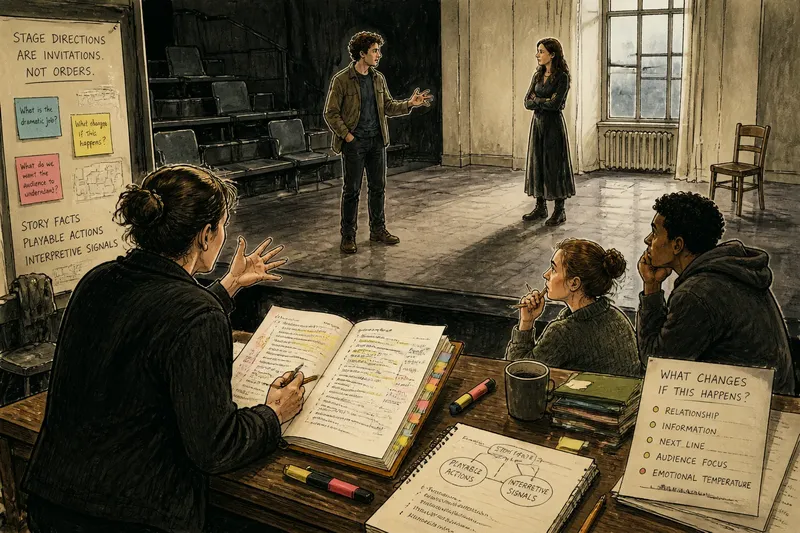
Mark each direction with a simple question: what changes if this happens? A movement might alter distance between characters. A sound might interrupt a thought. A lighting cue might reveal a place or draw attention to a shift in time. Once the change is clear, the production can consider more than one way to make it legible.
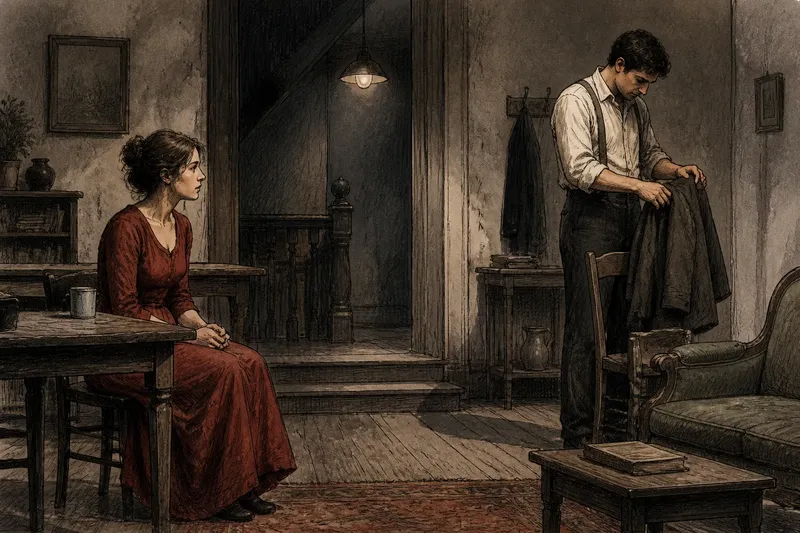
Some directions do state essential information. If the script says a character enters carrying a wet coat, the object may explain a later action or establish the weather. A choice that removes the coat could muddle the scene. The point is not to treat every detail as optional; it is to distinguish details that carry dramatic information from details that describe one possible means of delivering it.
Notice who wrote the direction and how it appears
Stage directions can come from the playwright, an editor, a translator, or a later publication process. Their placement and style offer clues, but they do not always identify their source. Directions in parentheses within dialogue may suggest delivery or movement; a longer opening description may establish the world. Neither form automatically tells you how much freedom a production has.
Compare editions when a direction seems to contradict the dialogue or the play’s basic action. One text may include a sound or gesture that another omits. If the work is translated, a movement or expression may also carry different associations in the language of performance. A director can consult the edition’s notes or publisher’s information, then decide whether the disputed detail affects the scene’s meaning.
It helps to keep three categories in view:
- Story facts: information the audience needs to understand what happens.
- Playable actions: directions that suggest a task, movement, or interaction.
- Interpretive signals: words that point toward mood, pace, or emphasis.
A direction can belong to more than one category. “He turns away, laughing” is a physical action and a cue about tone, but it may leave open whether the laugh is warm, defensive, or strained. That uncertainty can be useful material rather than a problem to eliminate.
Translate literal images into playable choices
Scripts often use vivid language to describe what a person or place feels like. “The room seems to hold its breath” may suggest stillness, tension, or an expectation that something will happen. It need not require actors to freeze or the sound designer to create an actual breath. The production can look for an observable choice—perhaps a conversation that stops just before an answer, or a character who waits at a doorway.
That translation should remain connected to the text. If an image suggests constriction, a broad, carefree comic rhythm may pull against it unless the contrast is deliberate. Ask what qualities the words offer: pressure, speed, distance, exposure, concealment. Then look for stage actions, vocal choices, objects, or shifts in focus that carry those qualities without illustrating every word literally.
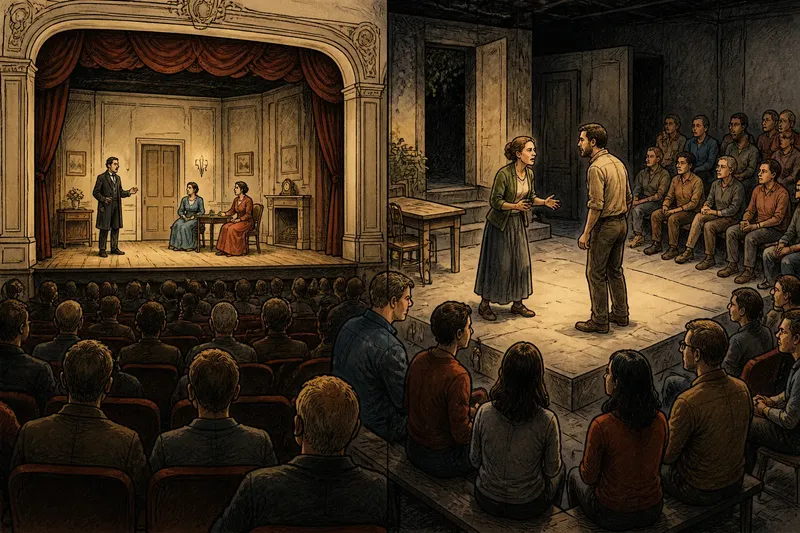
Imagine a scene direction describing a character as “pinned beneath the room’s silence.” In a small rehearsal space, the actor and director might decide that the character keeps attempting to speak but stops when another person turns toward them. The observable result is a pattern of interrupted speech and attention; no special set or sound effect is needed. Another production could choose a different image, provided the audience can still sense the character’s difficulty speaking.
Build a week of rehearsal around questions
A short rehearsal plan can keep interpretation grounded while leaving room for discovery. The aim is not to settle every direction in advance. It is to test what the text requires, identify where a choice matters, and make decisions that the performers can repeat.
- Day one: read without staging. Mark every direction that changes a relationship, reveals information, or affects the next line. Leave decorative details uncommitted for now.
- Day two: identify the playable action. For each marked direction, ask what a character wants, avoids, or notices. Translate abstract descriptions into actions an actor can actually attempt.
- Day three: try alternatives. Keep the scene’s required facts intact while varying movement, focus, or delivery. Compare what becomes clearer, more confusing, or unexpectedly comic.
- Day four: check the whole scene. Look at how one choice affects later entrances, objects, lines, and audience attention. A useful moment should fit the scene’s larger sequence, not only look striking on its own.
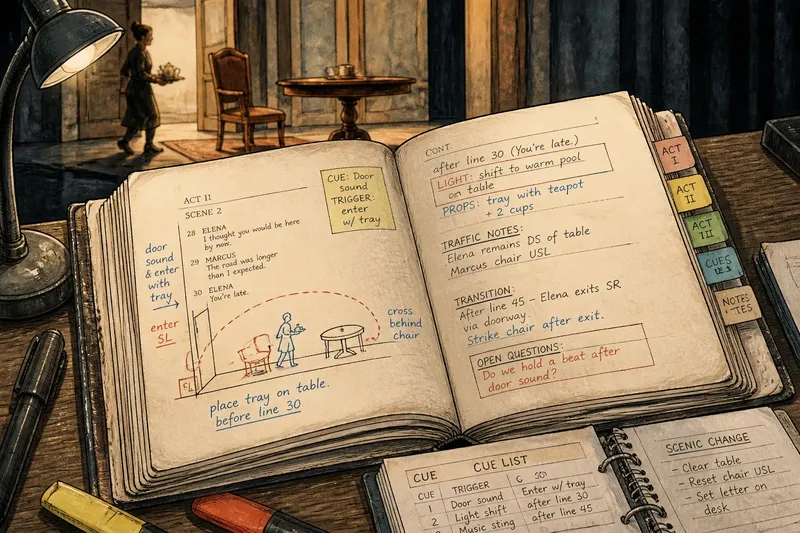
- Day five: settle a working version. Record the choice in the rehearsal script and note the reason for it. Treat the note as a decision the company can revisit if the scene stops working.
For this process, a pencil, removable page flags, and a shared rehearsal document are enough. Use one mark for directions that establish story facts and another for directions that invite interpretation. The distinction helps a director explain why a detail is being changed rather than making the change feel arbitrary.
Keep freedom from becoming vagueness
Interpretation needs a limit: the play’s available evidence. A production may relocate a movement, simplify a visual image, or change how a pause in action is expressed. It should still preserve the relationships and information the scene depends on. If an adaptation changes a fact, the company should understand what else that change alters.
Audience comprehension is a practical test. If a direction says a character recognizes an object, the production needs some readable sign of recognition, even if the object is represented differently. If a character leaves and later returns, the audience needs to understand that transition. The means can vary; the story’s necessary connection should not disappear.
When a director and actor disagree, return to the line before and the line after the direction. Ask what each version makes the audience notice, and whether that attention supports the scene. The answer may favor the printed suggestion, a new choice, or a compromise. The useful question is not “May we ignore this?” but “What must remain true for this scene to work?”
Which stage directions should a production preserve?
Are stage directions binding?
Some directions establish facts the plot depends on, while others suggest one way to express an idea. A production should identify which kind it is dealing with before deciding whether to alter the staging.
Can actors change a movement described in the script?
They can explore alternatives with the director, especially when a movement is difficult to perform or unclear in the rehearsal space. The replacement should preserve the action’s purpose, such as avoiding a gaze or drawing attention to an object.
What should a director do with poetic directions?
Look for the playable quality inside the image, such as pressure, stillness, or exposure. A physical or vocal choice can suggest that quality without reproducing the image literally.
When should a direction stay literal?
Keep it literal when the action supplies essential story information or when another choice would confuse the scene. If the reason is uncertain, compare the direction with the surrounding dialogue and the events that follow.
Make a choice the audience can read
Stage directions become useful when they lead to choices that are both imaginative and intelligible. A director can preserve their dramatic purpose while changing the visible method; an actor can use a descriptive phrase to find an action rather than a pose. That is the central value of reading them as clues: the words remain active, but the performance is not trapped in a single illustration.
When a direction seems to demand a literal effect, ask what the audience needs to understand at that moment. Then choose the simplest clear action that carries the same information or tension. Stage directions are not handcuffs; they are part of the play’s conversation with the people bringing it to life.